Example requests
These are real requests from finished reviews, quoted as they were typed, typos and all. A request does not need to be polished to work. The only edits are in square brackets.
Each example has the same parts:
- Request: what the user typed.
- Why it works: what in the request shaped the review.
- What the agent asked: the questions the request left open.
- Follow-ups: later messages in the same conversation.
- Result: what the review produced, with a picture of its main output.
For what to put in your own request, see Step 3 of the tutorial.
Requests that name what matters
Differences across cortical layers
Request.
do a new literature review of neurophysiology studies that have focused on differences across cortical layers. two important differences that people may have looked at are diffs in timing of communication, and differences in the representation of information. another is differences in spiking patterns or spiking characteristics. but there are certainly others. go back at least to the 1970s. include the most recent neuropixels results. organize the lanes and make the interactive html.
Why it works. The first sentence says what a paper must do to be included: treat the cortical layer as the thing being compared. The three named differences each became a search. "There are certainly others" let the agent add three more: brain rhythms, circuit wiring, and how layers change with state and learning. The request sets both ends of the time span, the 1970s and the latest Neuropixels recordings.
What the agent asked. Whether layer-resolved fMRI and MEG count (yes, as their own search). Whether brain-slice studies count (yes). Which brain areas (all of cortex, centered on primary visual cortex). How many papers (about 450–550).
Follow-ups. "write the review paper. at the end of the review answer the following question in debate format, including a pro position, an anti position, and a conclusion: "layers are functionally important". support your debate points with citations from the bibliography."
Result. 555 papers from 1909 to 2026, in six families, and a written review that ends in a debate.
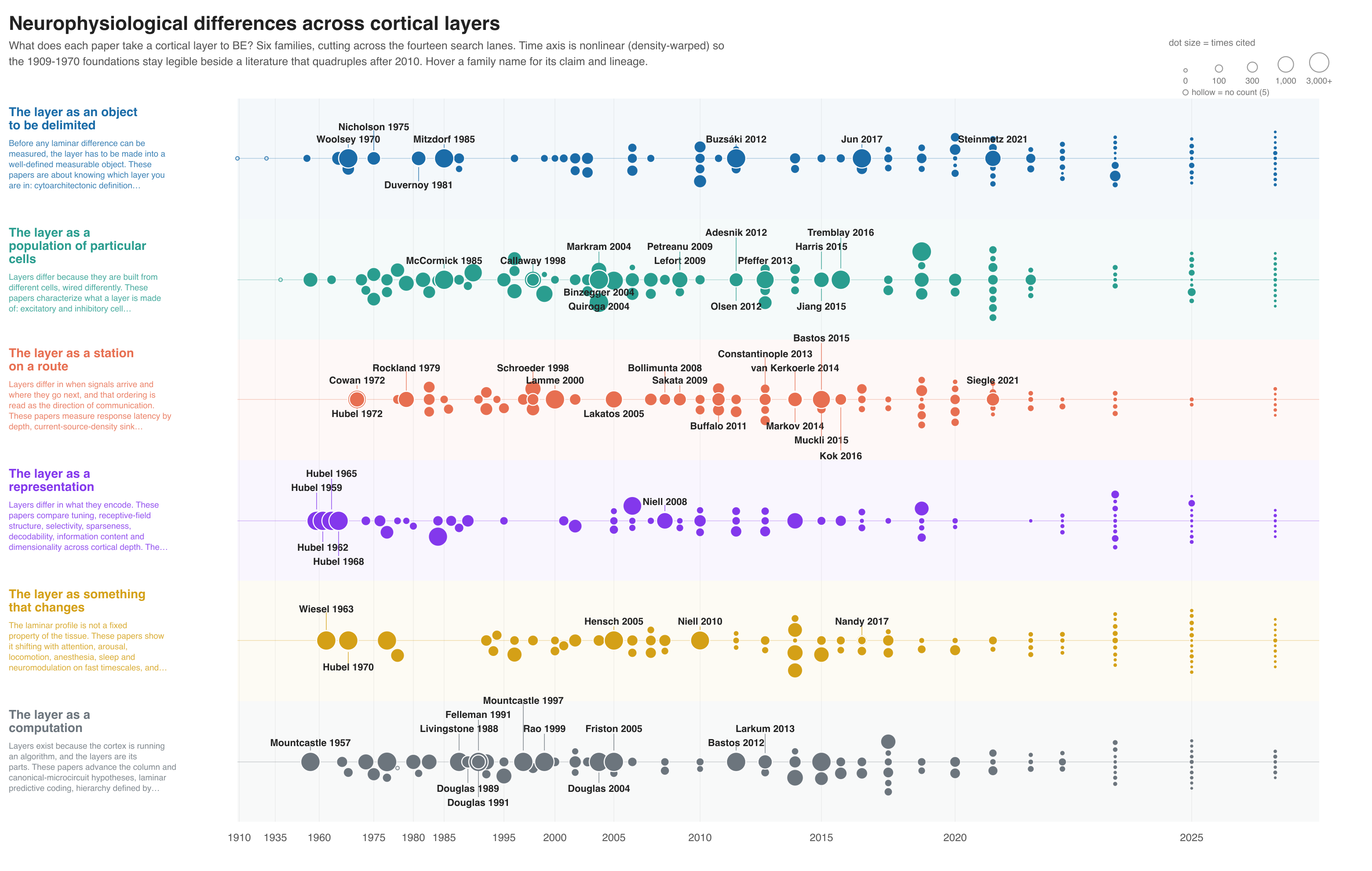
The timeline from this request. Each lane is one answer to the question of what a cortical layer is.
Linear and nonlinear summation
Request.
run a new bibliography search. the focus should be on linear versus nonlinear summation in the neurophysiological responses of neurons. i suspect that much of the literature will come from vision studies. also include any such studies that used other brain measurements, such as fMRI or EEG. the oldest studies on this may be from the 1950s.
Why it works. It says where most papers probably are (vision), and still widens the search to other measurements. A guess about the oldest studies tells the agent how far back to search for the field's roots.
What the agent asked. Which kinds of summation count. Receptive-field summation, combining the two eyes or two senses, and other senses were in. Summation within single dendrites was out.
Follow-ups. "write the review paper. be sure to follow gallant lab guidelines in ../WRITING/". Pointing to a style guide made the written review follow the lab's writing rules.
Result. 874 papers in six families, and a written review citing 499 of them.
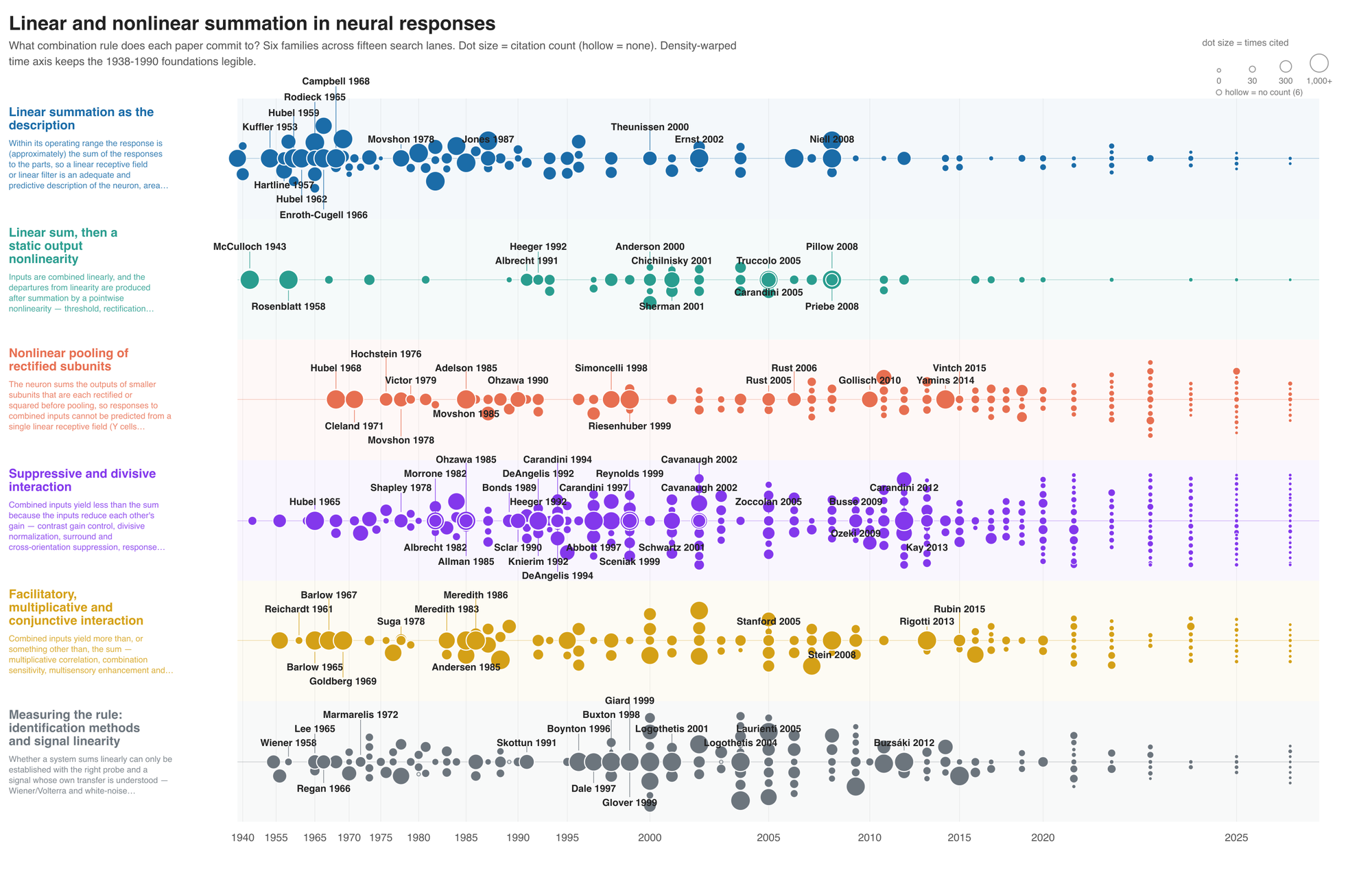
The timeline from this request. Each lane is a different rule for how a neuron combines its inputs.
The alignment problem in AI
Request.
run another bibliography search on the "alignment" problem in AI. include theoretical/philosophical/opinion pieces on the problem, papers on how to measure it, and papers on how to fix it.
Why it works. It names three kinds of work in one sentence: the problem, how to measure it and how to fix it. The agent covered all three equally. Naming opinion pieces kept them in; a search for experiments alone would have dropped them.
Follow-ups. "the timeline families are fine, do it."
Result. 475 papers in seven families.
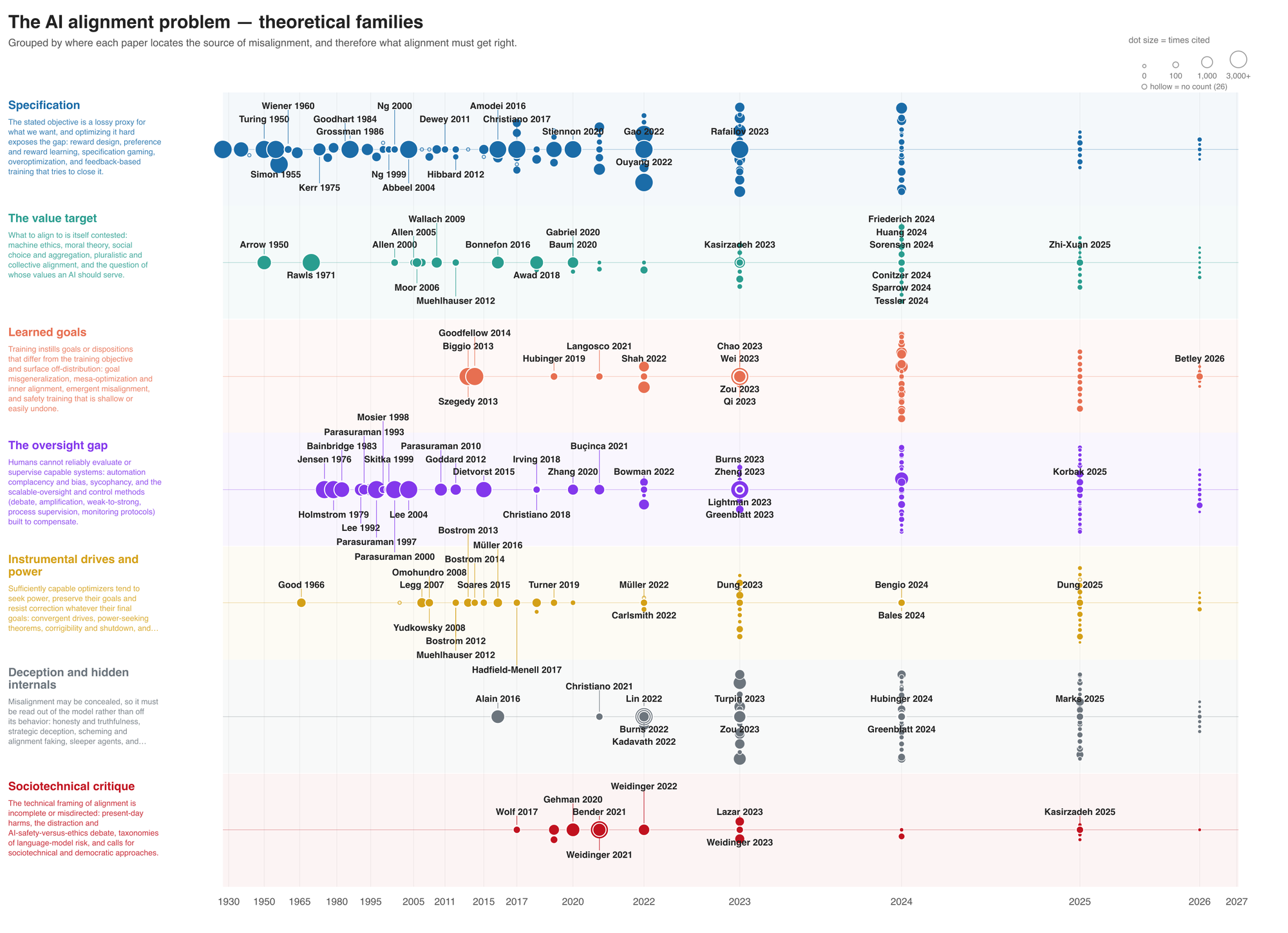
The timeline from this request. Each lane locates the source of misalignment in a different place, and so asks something different of alignment.
Creatine deficiency
Request.
do a new literature search on creatine transporter deficiancy. cover the history of research in the field. be sure to include cerebral creatine deficiencies (AGAT and GAMT). also cover the history and current state of treatments for these disorders. be sure to cover creatine MRS imaging as a diagnostic tool.
Why it works. It reads like a table of contents. Each sentence became a search: the main disorder, its two relatives, treatment, and the imaging method used to diagnose it.
Follow-ups. A request for a written review, and a question about the papers: "i am particulary interested in any HUMAN anatomy studies that look at physical anatomy (ultrastructure, synpases, neurons, etc) in creatine disorders. are there any?"
Result. 587 papers from 1886 to 2026, in seven families, and a written review citing 244 of them.
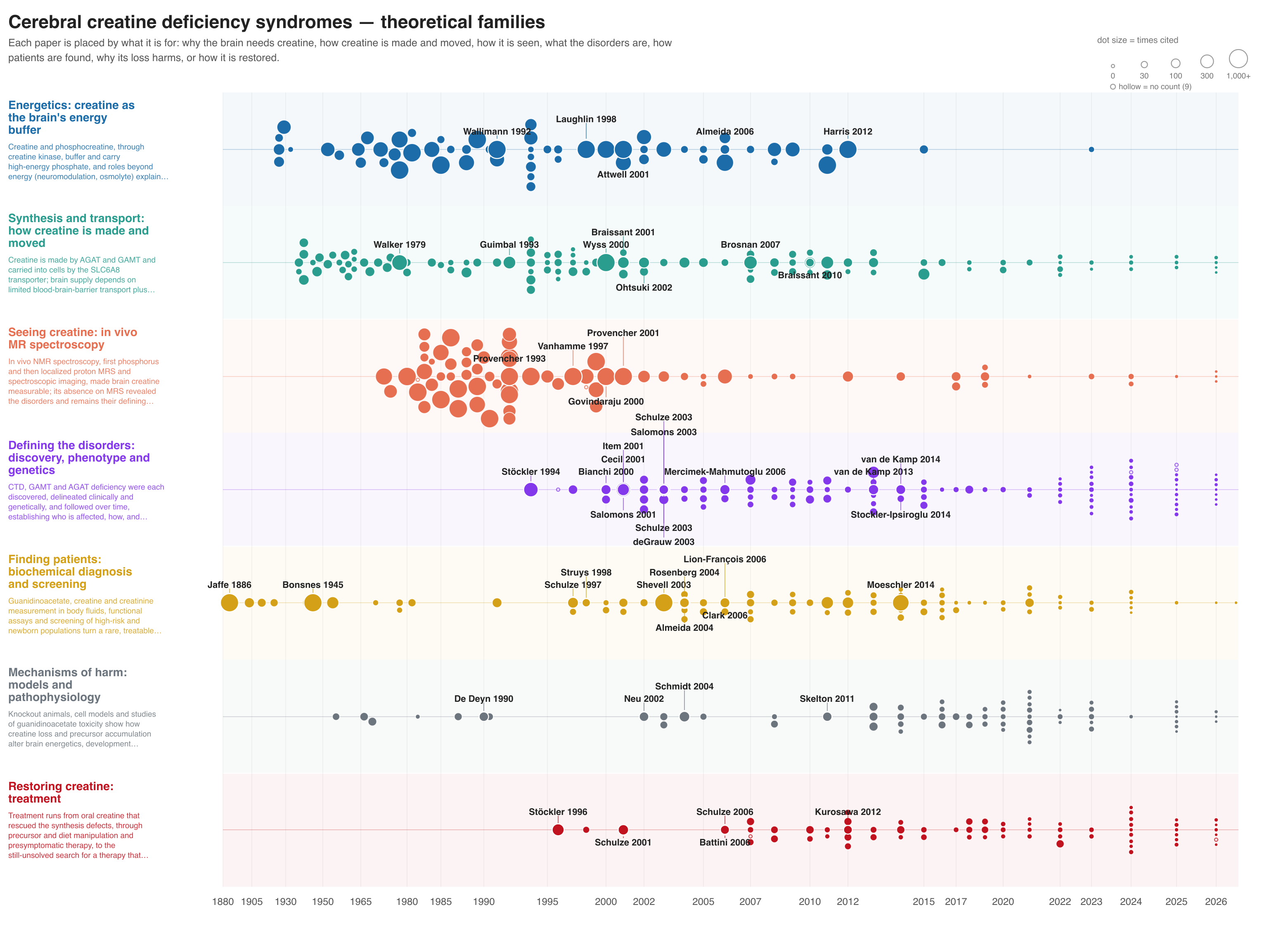
The timeline from this request. Each lane is one part of the story, from why the brain needs creatine to how it is restored.
Requests built on papers you know
Networks trained end-to-end on neural data
Request.
run a quick, very specific search for papers that train neural networks end-to-end to model neurophysiological data from humans or animals. as far as i know the only papers that do this are (1) "Lau, B., Stanley, G. B., & Dan, Y. (2002). Computational subunits of visual cortical neurons revealed by artificial neural networks. Proceedings of the National Academy of Sciences, 99(13), 8974-8979.", (2) "Prenger, R., Wu, M. C. K., David, S. V., & Gallant, J. L. (2004). Nonlinear V1 responses to natural scenes revealed by neural network analysis. Neural Networks, 17(5-6), 663-679." and (3) "Oliver, M., Winter, M., Dupré la Tour, T., Eickenberg, M., & Gallant, J. L. (2024). A biologically-inspired hierarchical convolutional energy model predicts V4 responses to natural videos. bioRxiv, 2024-12." i want to know if there are any other papers out there. i do NOT need the taxonomy / timeline figure or a summary paper, i just need references. BE SPECIFIC.
Why it works. Three full references define the method more precisely than any description could. "Very specific" kept the search narrow: networks whose weights are fit to recorded brain responses. Saying what was not needed kept the first pass to a quick list.
Follow-ups. The quick search found far more papers than expected, so the user asked for the full review: "please write a spreadsheet file like you usually do, along with the other stuff that you usually save. and since there are a LOT more papers than i thought, go ahead and do the taxonomy figure and whatever else you usually do." Later the user spotted an error: "at least some of the papers in your bib were NOT TRAINED END TO END. for example, [Wang et al., 2025, Nature] AFAIK used a pre-trained model." The agent then checked every paper's methods and marked the ones built on pretrained networks. Starting small is fine, and so is correcting course with one example.
Result. 168 papers in four families.
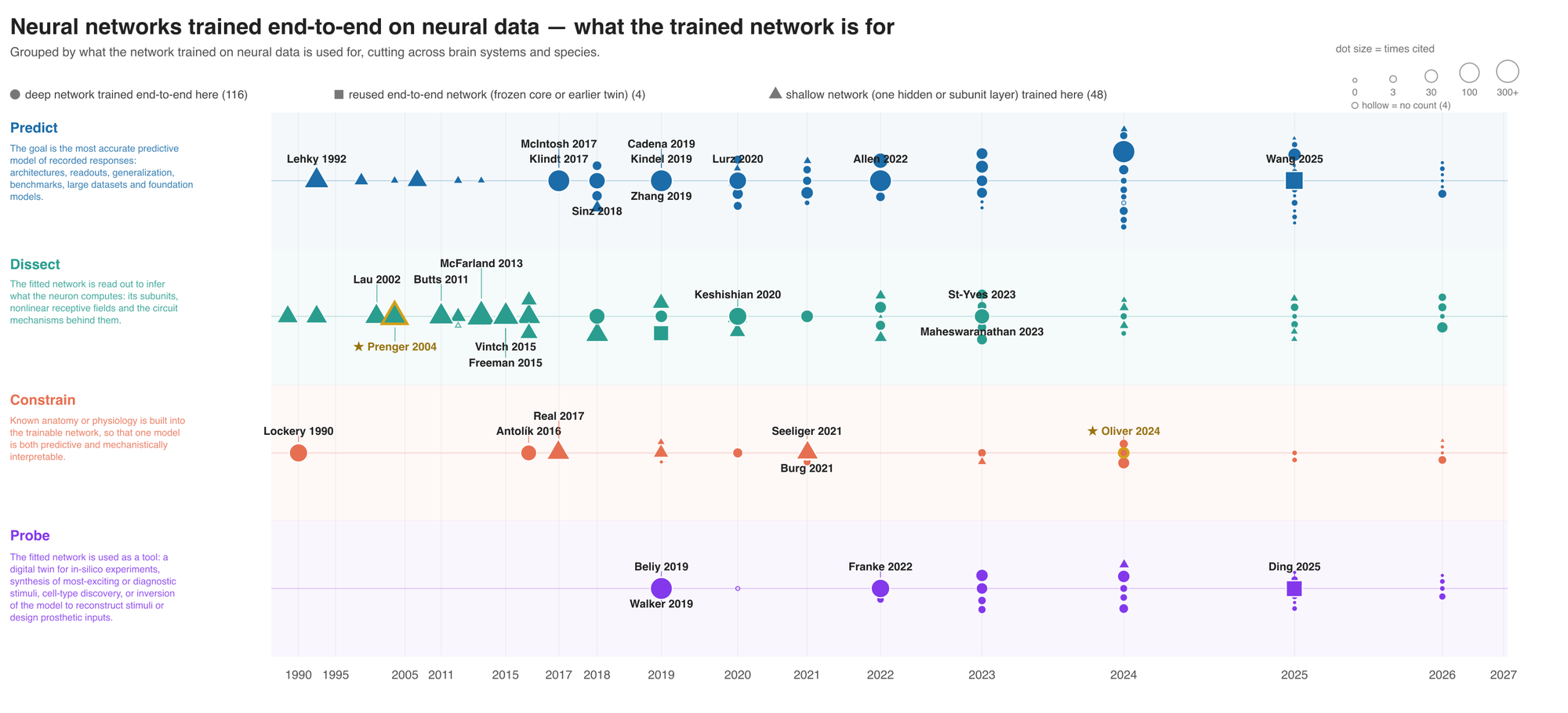
The timeline from this request. Each lane is what the trained network is used for. The dot shapes mark deep networks trained end to end, reused pretrained networks and shallow networks: the distinction the user's correction asked for.
Synthesizing images to probe visual neurons
Request.
i want a review on the use of generative models and/or genetic algorithms to understand how neurons or brain areas represent visual information. some relevant papers are:
ce connor current biology 2021 "Early Emergence of Solid Shape Coding in Natural and Deep Network Vision"
af luo neurips 2024 "Brain diffusion for visual exploration..."
but there are many other papers. i want to know what is the earliest paper that did this, and then do the evolution of the method.
Why it works. Asking for "the earliest paper that did this" makes the history the point, so the agent searched methods from before deep learning. Two papers, remembered only by initials and part of a title, fixed what "this" means. "There are many other papers" says they are examples, not the whole list.
What the agent asked. How broad "generative" should be. The user chose the broad reading, which excludes decoding images from brain activity.
Result. 415 papers in five families. Checking corrected both remembered papers: the first is by Srinath et al., with Connor as senior author, and the second appeared at NeurIPS in 2023, not 2024. Details from memory are fine in a request.
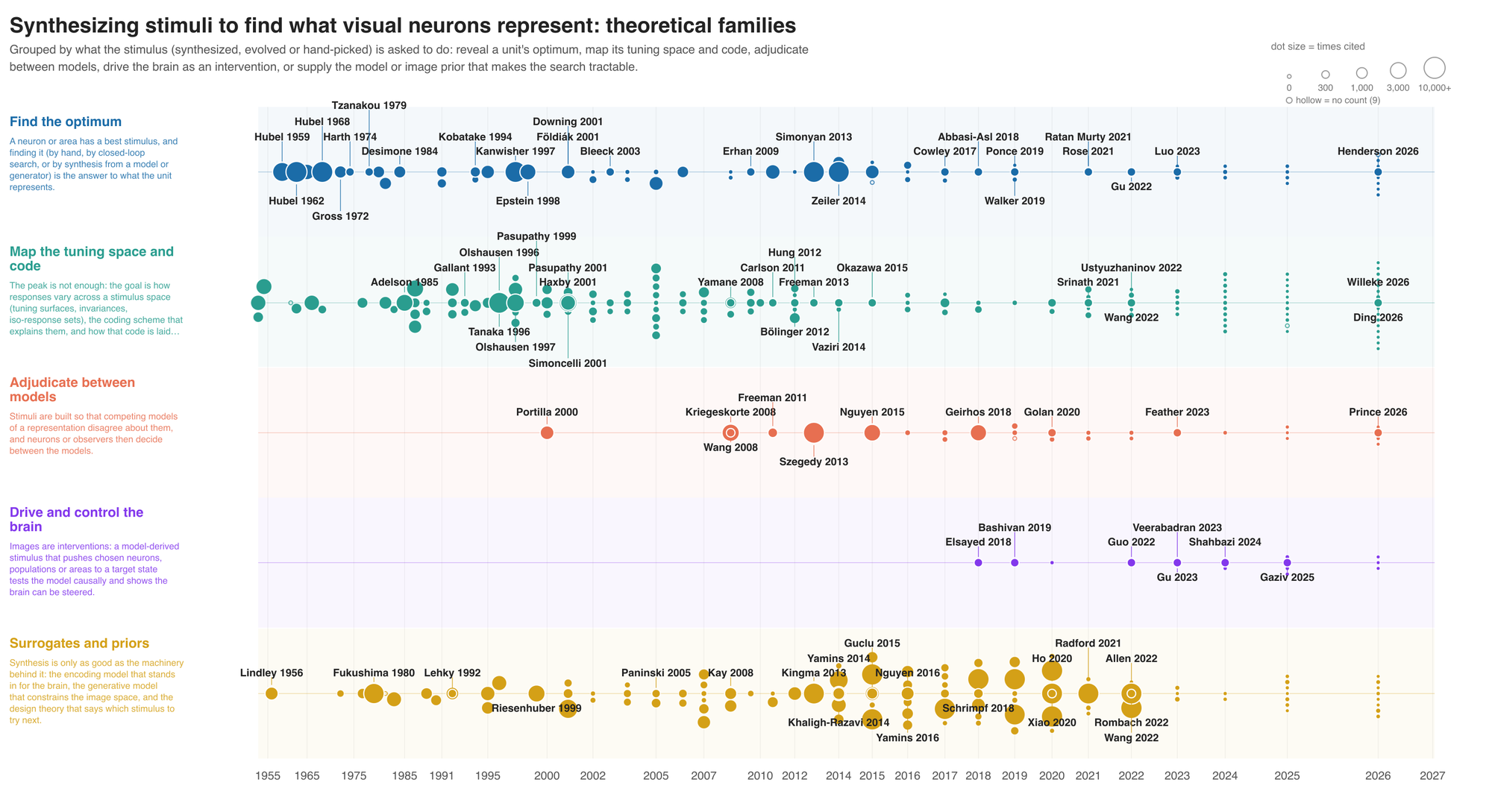
The timeline from this request. Each lane is a job the synthesized image does: find a neuron's preferred stimulus, map its tuning, decide between models, drive the brain, or stand in for a model's assumptions.
Requests that describe the output
How accurate is diagnosis?
Request.
i want to run a literature review specifically focused on the accuracy of diagnosis of brain disorders and mental disorders. i want to evaluate all classes of diagnosis: antomy, genetics, and behavior. in the end i want you to make TWO html plots, one where the rows are the disorders, and one where the rows are anatomy, genetics, and behavior. then based on that literature review, i want you to give me summary statitics about how accurate diagnosis is as of today. be SURE to cite all the relevant citations when you give me the summary, and to flag the most important papers that you used to create the summary.
Why it works. It describes the finished product, so the agent planned backward from it. Plotting accuracy needs numbers, so the agent added a step that copies each accuracy figure from a paper's abstract, with a word-for-word quote that a script then checks.
What the agent asked. Whether to favor summaries of many studies or single studies (summaries, plus landmark single studies). How many disorders (about 20). Whether to add a fourth kind of evidence, brain physiology and blood tests (yes). Whether to include machine-learning classifiers (no).
Follow-ups. "can you do an after-analysis that summarizes this information just for fMRI? it would be helpful if you could break the fMRI results into different approaches, like resting state, task-based, etc." Most fMRI results come from machine-learning classifiers, which the first review had left out, so the agent asked how to treat them: "i'm fine with 1, but the fMRI stuff needs to be broken out so that it can be evaluated separately from the other studies." The fMRI analysis became a separate review, so it does not change the first review's numbers.
Result. 745 papers, two plots and a summary page with its sources. The fMRI review added 582 papers.
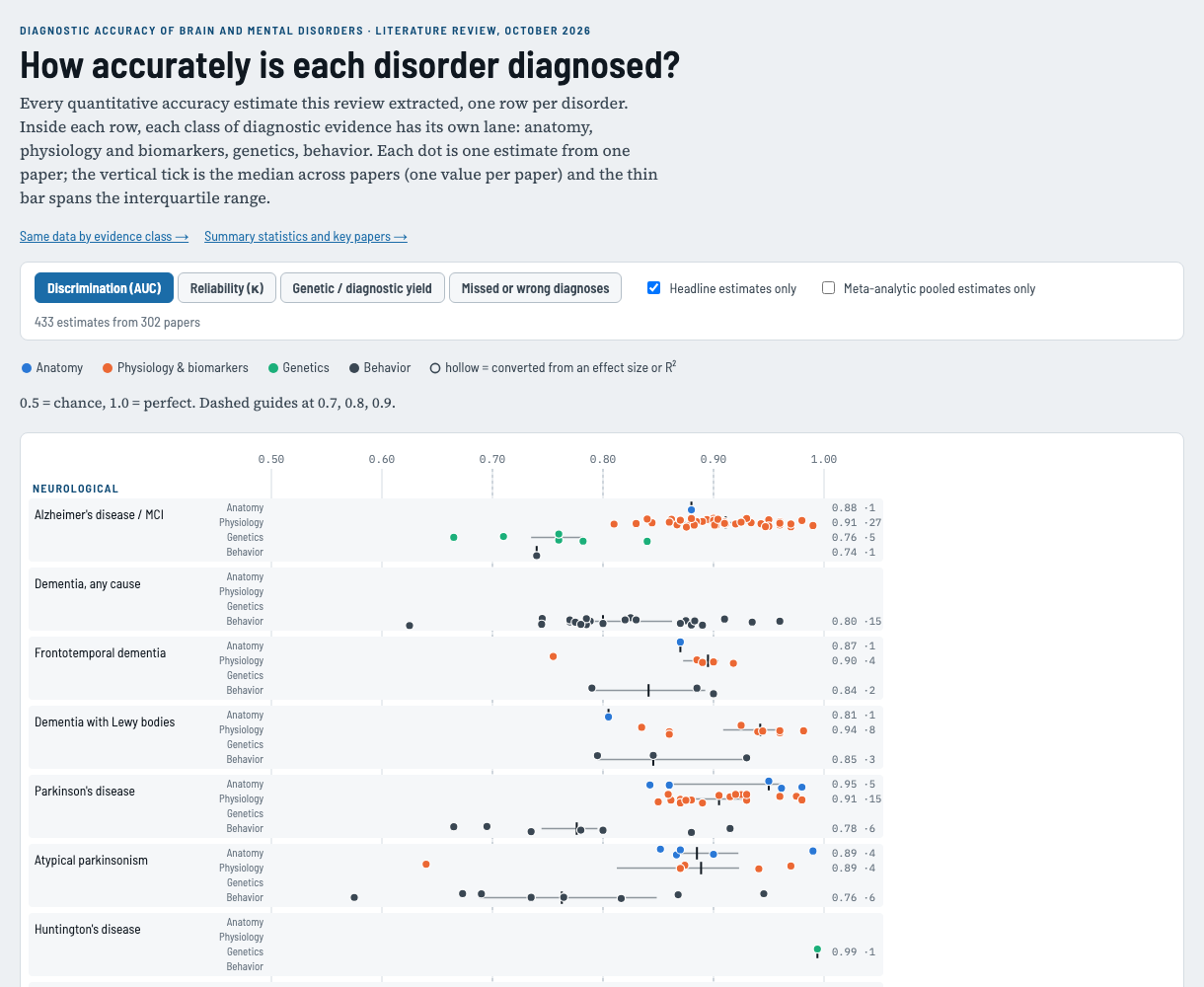
One of the two plots this request asked for. Diagnostic accuracy for each disorder, with each kind of evidence in its own lane. Each dot is one estimate from one paper.
A therapy you doubt
Request.
do a literature search on microtesla magnetic therapy. personally i don't think that this could possibly do anything, i am very skeptical. give me the pro- and anti- sides.
A few minutes later:
there is a company [name and website], figure out what field they use and target that.
Why it works. "The pro- and anti- sides" asks for an assessment, not a survey, so the agent searched both sides equally and grouped papers by what they found. Pointing at a real device let the agent pin down the claim from the company's patent: the frequency, the field strength and the dose. Studies of fields a thousand times stronger could then be set aside.
Result. 668 papers in eight families, and a written review that gives the case for, the case against and a verdict, citing 199 papers.
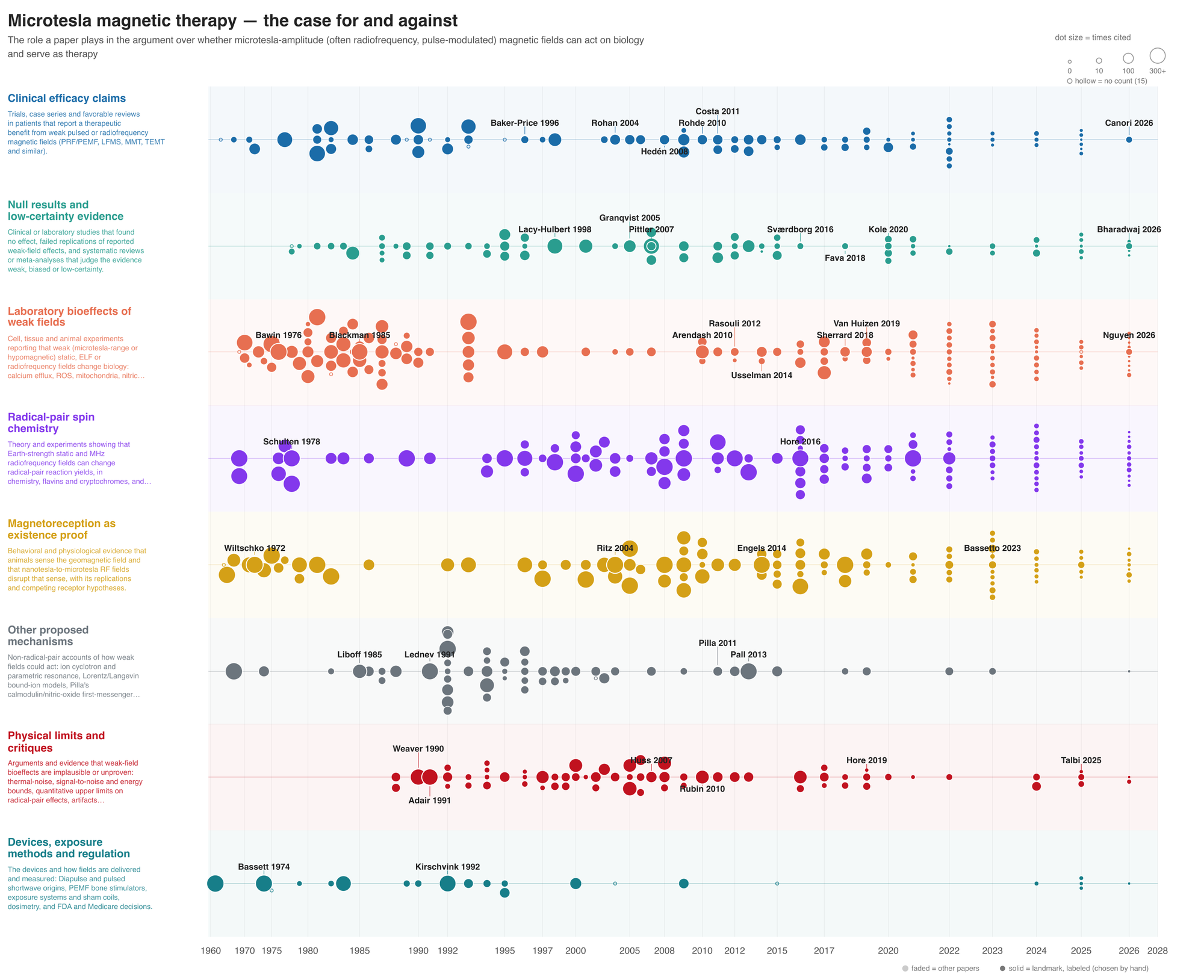
The timeline from this request. Each lane is the role a paper plays in the argument: evidence for, evidence against, and the mechanisms each side proposes.
Short requests
Short requests work too. The agent writes down how it read the request, and asks when something is unclear.
Reverse Polish notation
Request.
Do a literature review and find all the psychology and/or neuroscience studies on reverse Polish notation.
Why it works. "Find all" told the agent to take the widest reasonable reading: any study of how people read, learn or use notation written in operator-last or stack order. That took in calculator design, programming and mathematics teaching.
Result. 177 papers. Only seven are experiments comparing notations, and they disagree.
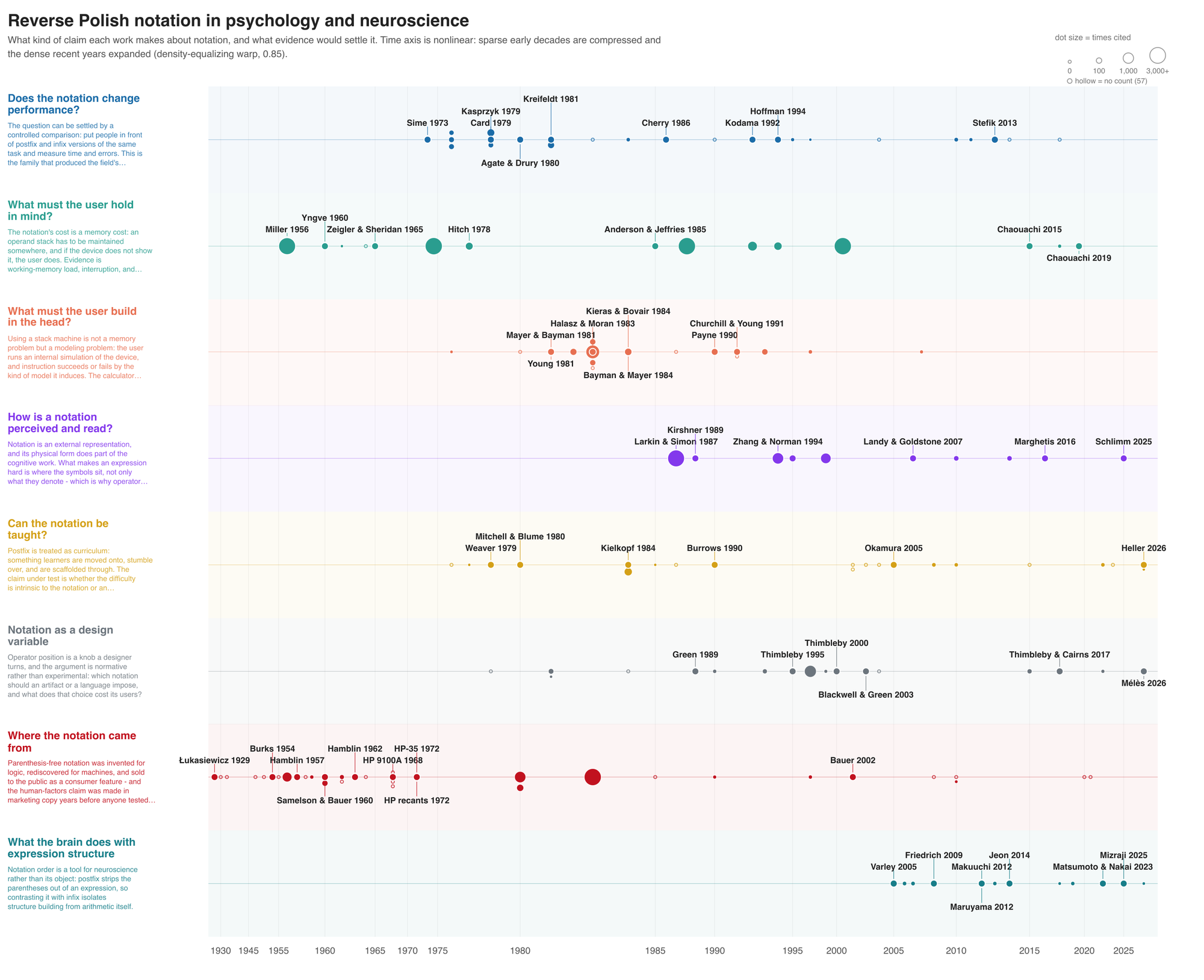
The timeline from this request. Each lane is a kind of claim about notation. The notes mark when the few experiments were done.
Meditation and brain networks
Request.
Do a literature review on how brain networks are affected by meditation.
What the agent asked. Which methods and which people. The user chose the widest answer each time: fMRI, EEG, MEG, brain structure and brain chemistry; experienced meditators and beginners, patients, children and older adults.
Result. 396 papers in six families.
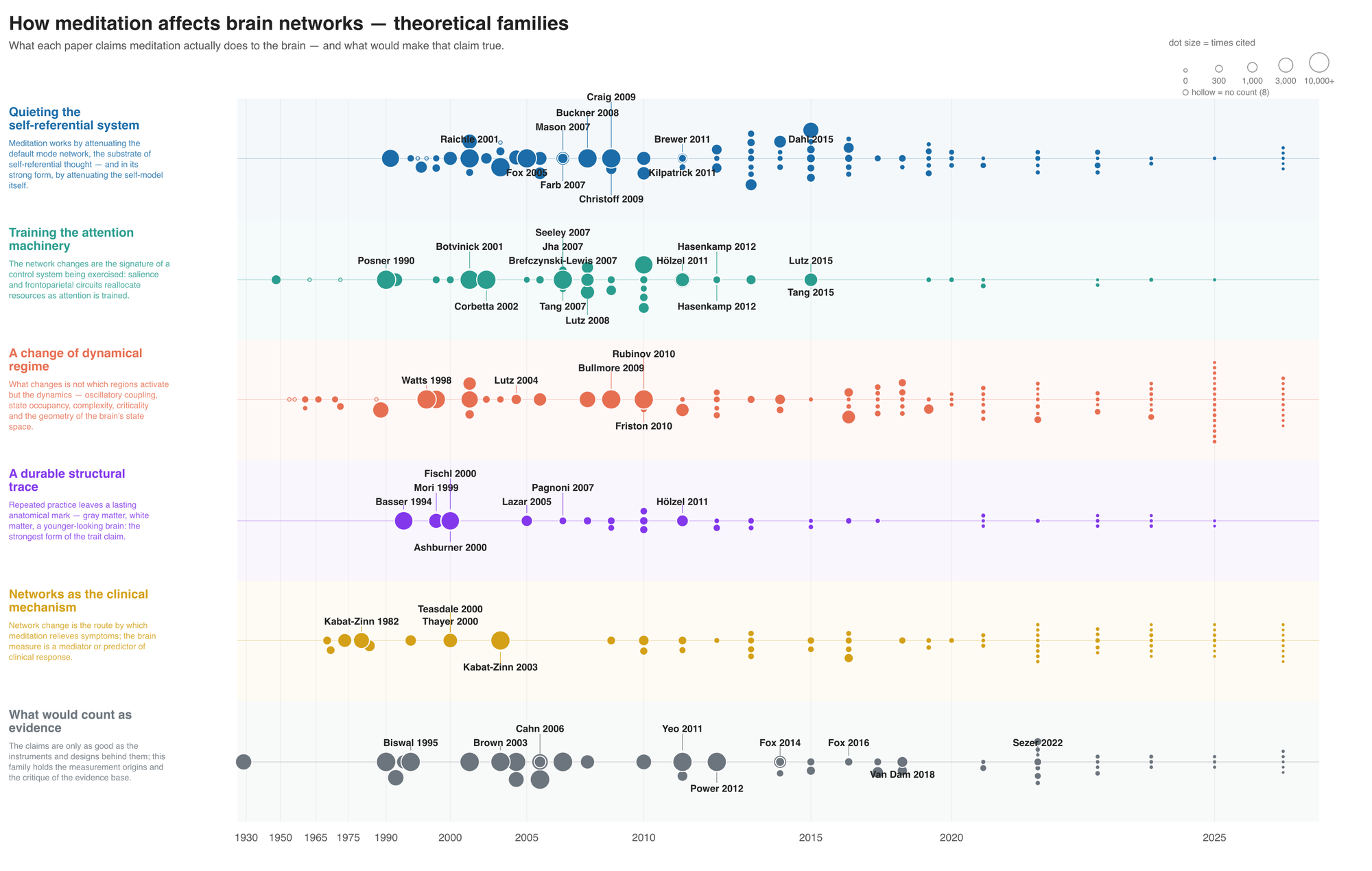
The timeline from this request. Each lane is a claim about what meditation does to the brain.