Topic mode vs lab mode
The toolkit has two front ends. They differ only in where the corpus comes from; once a verified set of papers exists, both run the identical verify → canonicalize → count → cross-reference → families → figure → review backbone.
| Topic mode | Lab mode | |
|---|---|---|
| Start from | a question | a lab's publication corpus |
| Direction | search outward from the topic | derive themes inward, then place them in the field |
| Front-end phases | 1 scope → 2 search → 2b antecedents | L1 ingest → L2 prune → L3 derive themes |
| Shared backbone | 3 verify → 3f canon → 5/5b → 6 xref → 6b families → 7 review → 8 | (identical) |
| The question it answers | "What's known about X?" | "What has this lab done, and where does it sit in the field?" |
Topic mode
The default. You give a question and a span; the agent searches outward, runs the required antecedents pass for the roots, and the backbone takes over. This is the flow described throughout The pipeline and Phases in detail.
"I want a literature review on the anatomical connections between the visual system and the cerebellum — any anatomy papers, primate or human, any tractography method, back to the 1970s."
Lab mode
Lab mode inverts the front end: instead of starting from a query, it starts from a known body of work — a lab's output — derives the lab's research themes and how they shifted over time, and only then searches outward to place that work in the surrounding field.
L1 — Ingest the corpus
python3 ../tools/lab_corpus.py --search "Jack Gallant"          # find the OpenAlex id
python3 ../tools/lab_corpus.py --author A5056348548 --out lab_papers.json
tools/lab_corpus.py
pulls a PI's authored works from OpenAlex (pass several --author ids for
PI + key members to widen coverage). Each row carries title / year / DOI / APA /
venue / citation count / topics / abstract / coauthors / type.
L2 — Prune false positives (human decision)
Author disambiguation is the #1 correctness risk in lab mode — OpenAlex will fold in same-name authors. You review the ingested list and drop the false-positives before anything is themed.
L3 — Derive themes and their drift
The agent derives the lab's research themes from the (abstract-enriched) corpus and tracks how emphasis moved over time. OpenAlex's light topic metadata alone is not enough — abstracts are enriched first. The themes become the lanes the rest of the pipeline uses.
Lab mode antecedents include the lab's own pre-paradigm work
The antecedents pass (still required) must surface the lab's own foundational work — e.g. macaque physiology that predates the lab's current human-imaging paradigm. An inclusion filter like "human fMRI only" must not silently drop those papers; they're re-entered as lab-sourced (and starred).
Then: the shared backbone
From verification onward, lab mode is identical to topic mode — every reference verified and canonicalized, counts fetched, cross-citations mined, and optionally a families figure and review article. The figure and review are contextualized: they show the lab's work against the field it sits in.
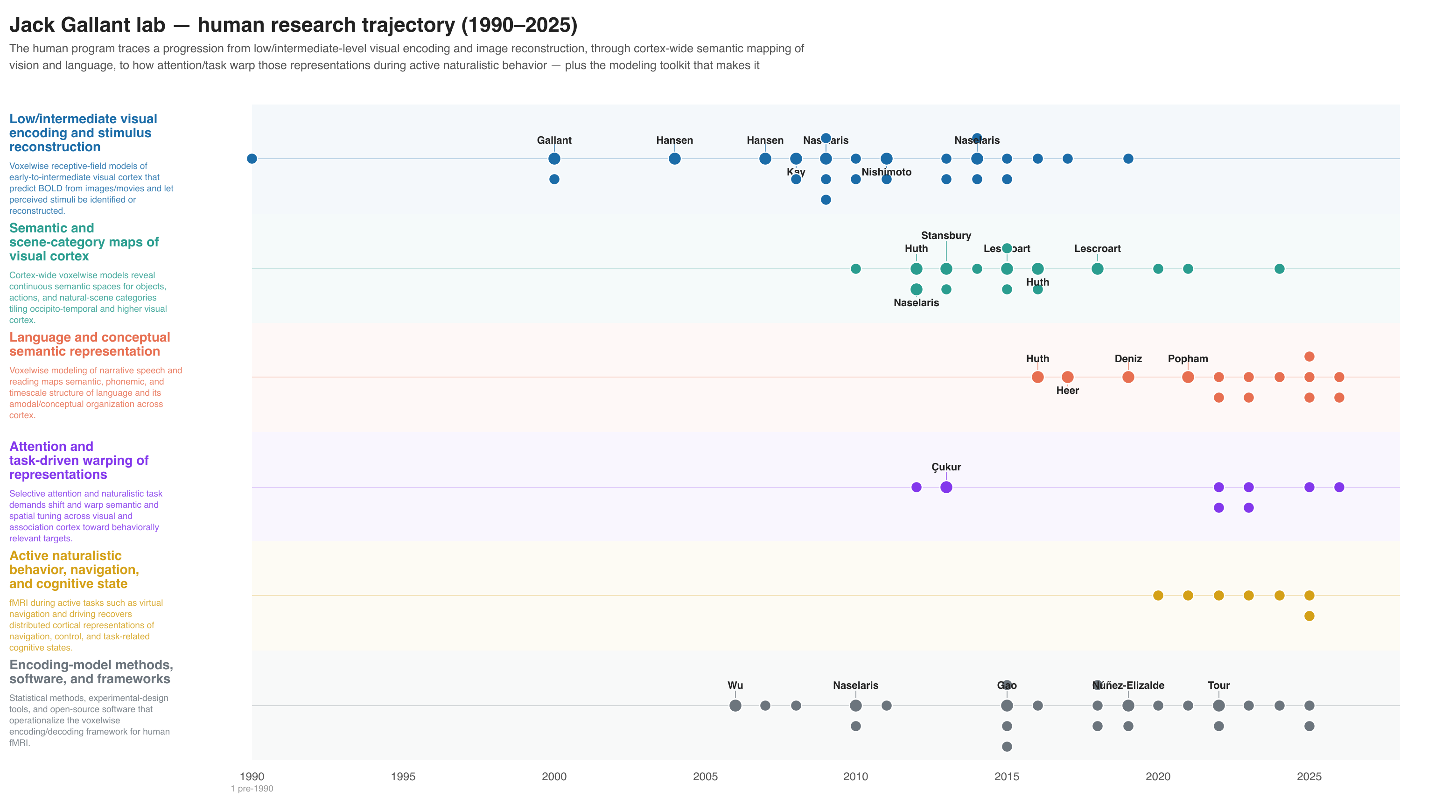
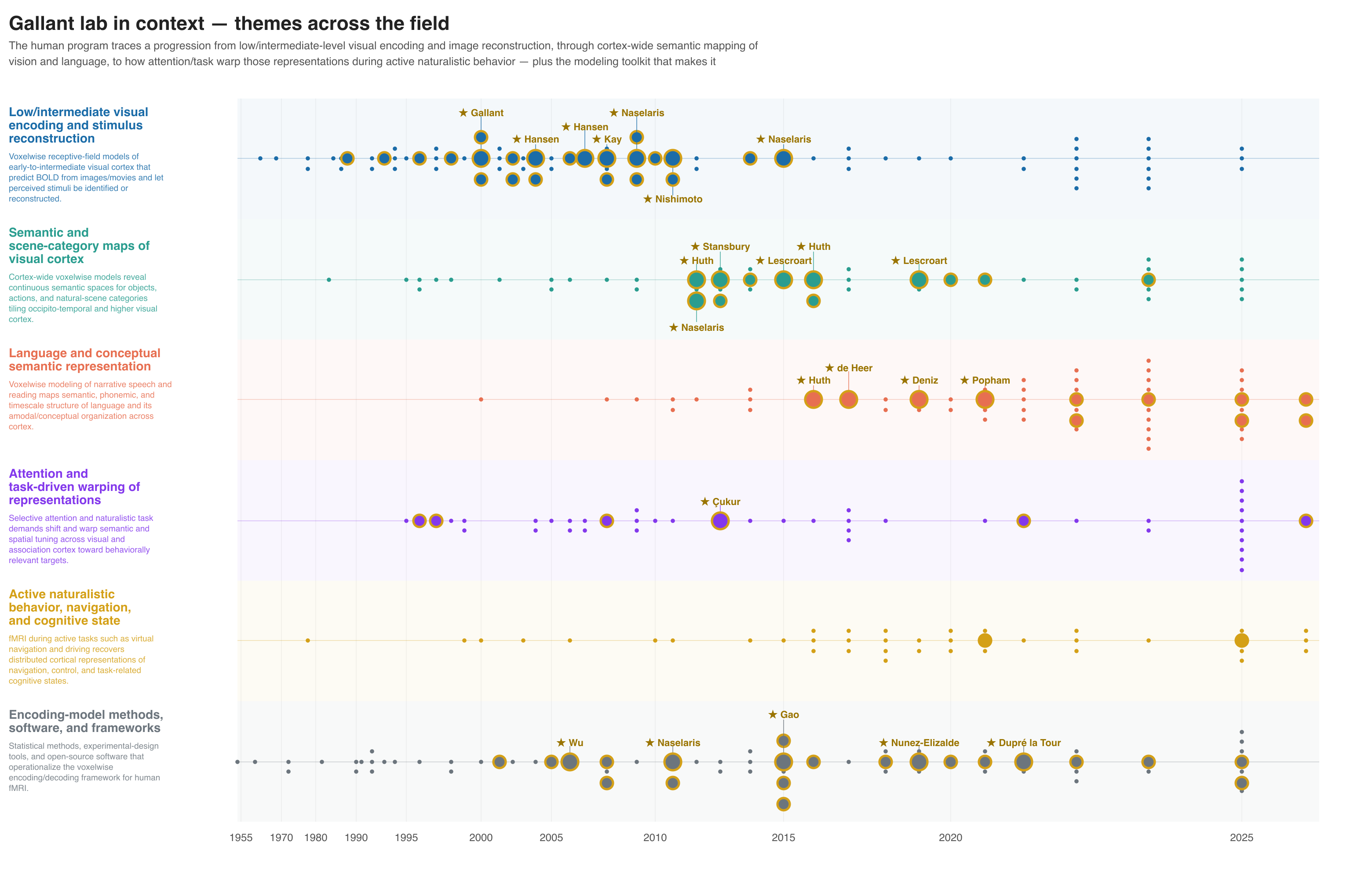
See the gallant_lab worked example
for the full run.