Cognitive · systems · computational neuroscience
How the brain works in real life, not just in a lab experiment.
We record brain function in people watching movies, hearing stories, and playing games, then build computational models of perception, cognition, and action as they actually happen.
Recent news
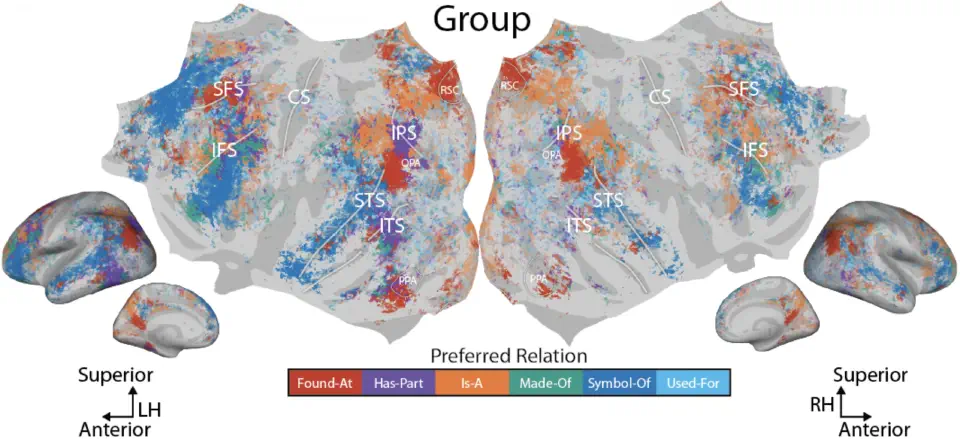
Dr. Catherine Chen's study of semantic relations has been accepted in Nature Human Behaviour!
Dr. Catherine Chen’s study of how semantic relations are represented in the human brain has been accepted in Nature Human Behaviour. The paper has not yet appeared in print but you can find a preprint here.
Participants answered relation-verification questions about over 1000 concept pairs (e.g., bicycle has-part wheel), and voxelwise encoding models were used to identify where and how each relation is represented. Semantic relations are encoded in the same bilateral temporal, parietal, and prefrontal regions as other semantic concepts, though most voxels are selective for only one specific relation.
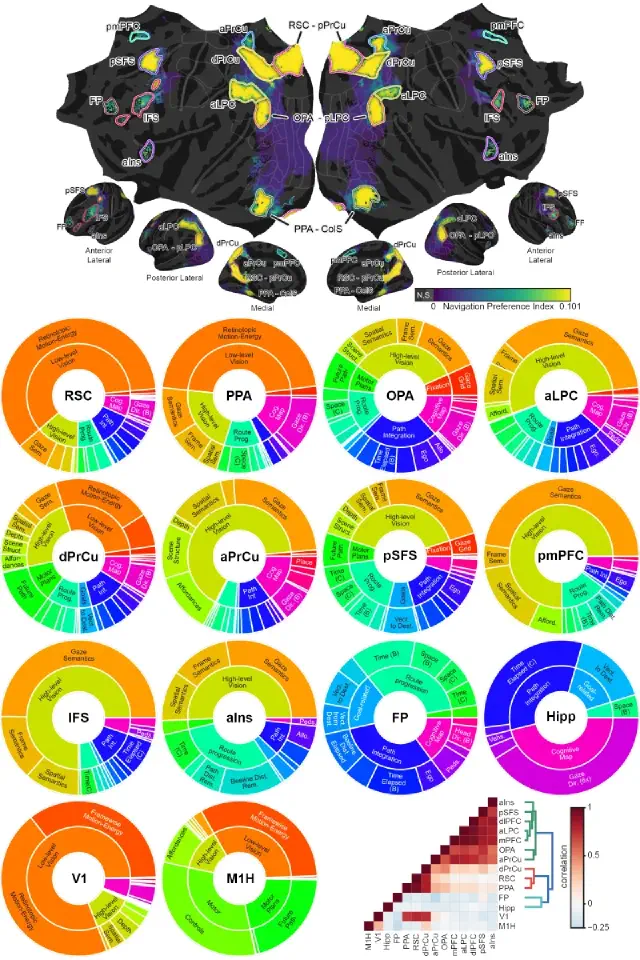
Dr. Tianjiao Zhang's landmark study of naturalistic navigation has been accepted in Nature Neuroscience!
The paper has not yet appeared in print but you can find a preprint here.
Briefly, participants performed a taxi driver task in a large virtual world. Voxelwise encoding models were used to fit 38 different feature spaces (comprising an astounding 28,134 distinct features) to the data. Results show that naturalistic navigation is supported by a network of 11 functionally distinct cortical regions that operate together to transform perceptual inputs through decision-making processes to produce action outputs. This paper really pushes the boundaries of what is possible in fMRI, no one has ever done anything at this scale before.
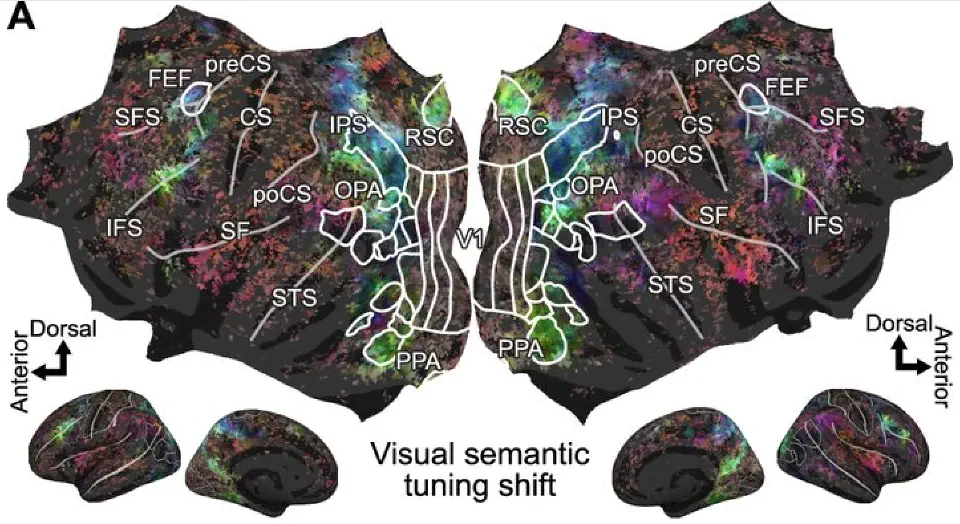
Dr. Tianjiao Zhang has a new paper accepted in eNeuro.
Dr. Tianjiao Zhang has a new paper accepted in eNeuro.
This study compares semantic representations during passive movie watching to those measured during naturalistic navigation. The results show that attention in different task contexts alters semantic representations to optimize task performance.
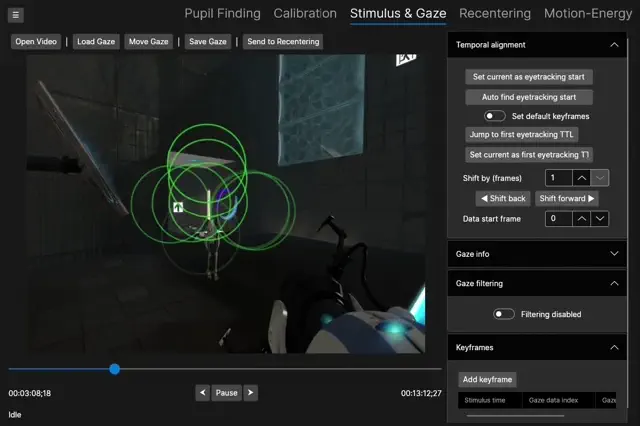
We've released SharpEyes, an application for eyetracking and motion-energy features...
We’ve released SharpEyes, a desktop application for eyetracking and for building motion-energy features out of stimulus videos.
It finds the pupil in every frame of an eyetracking video, lets you hand-correct the gaze overlaid on the stimulus, recenters the stimulus on gaze to produce a retinotopic video, and computes motion-energy features — all without touching Python. Precompiled Windows and Linux builds are on the releases page.
Thanks to Dr. Tianjiao Zhang for developing this tool!
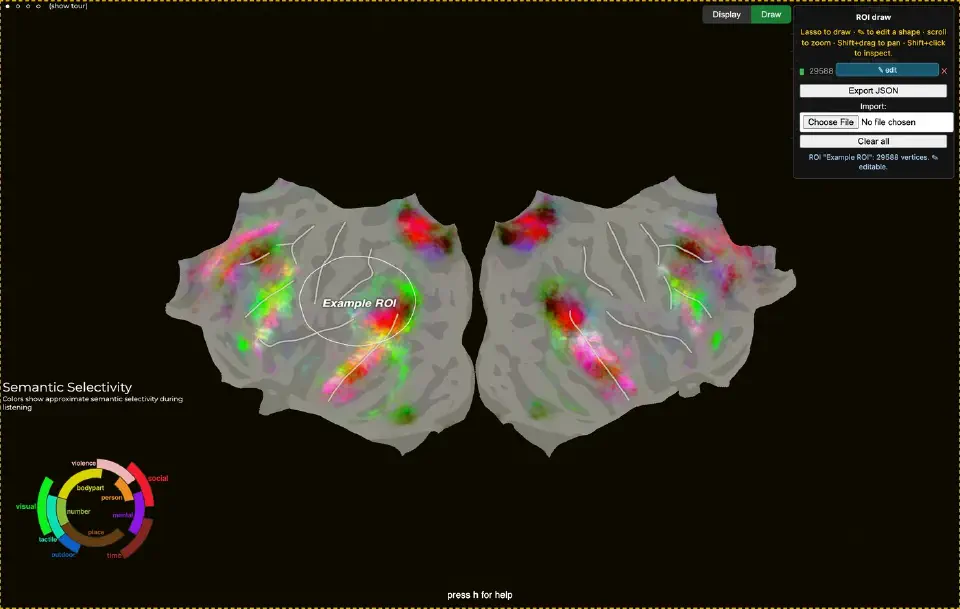
Pycortex, our awesome brain viewer software, has another new feature: in-browser ROI drawing...
Pycortex, our awesome brain viewer software, has another new feature!
You can now draw regions of interest directly in any pycortex WebGL brain viewer. Switch to Draw mode, lasso an area on the flattened cortical surface, and the stroke is fitted to a smooth, editable outline that you can name, export to JSON, and re-import across viewers. The drawing tool ships as a single self-contained script — pycortex-roidraw — that can be dropped into any pycortex viewer. Try it out in our updated group-based language comprehension semantic map viewer.
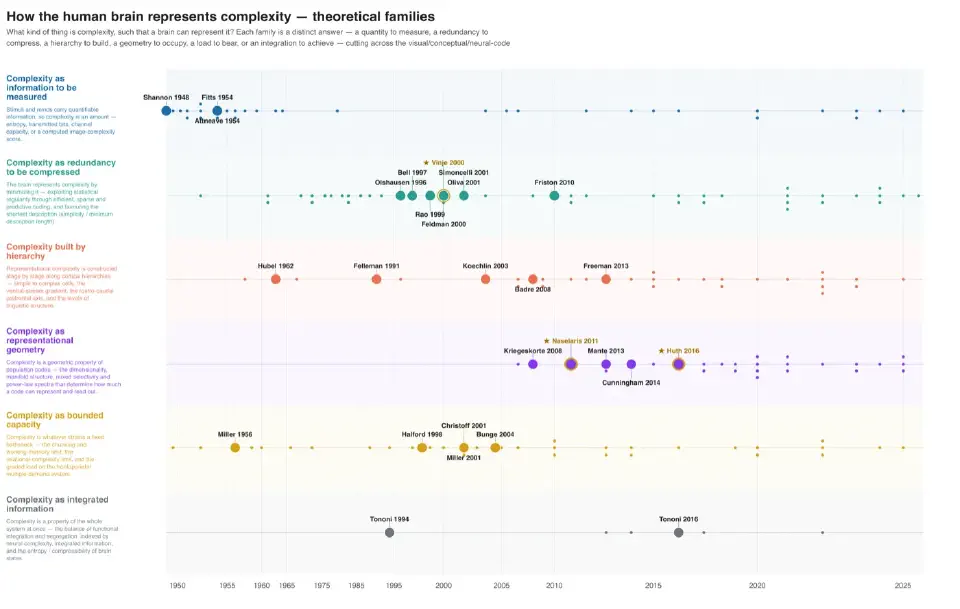
We've released the Literature Review Toolkit, scaffolding that drives an LLM agent through a structured literature review — and keeps it honest...
We’ve released the Literature Review Toolkit, scaffolding that drives a Claude (or other LLM) agent through a structured literature review — and keeps it honest.
It verifies every citation against PubMed, PMC, CrossRef, and arXiv, canonicalizes references into APA-7 format, and produces a verified annotated bibliography along with interactive lineage figures that place theoretical families on a citation-weighted timeline.
Viewer Spotlight
Concepts in the brain
Conceptual information is represented in many regions of the human brain. These representations can be recovered by using fMRI to measure brain activity while participants listen to natural narrative stories. This map was created by pooling data across 24 individuals. Switch to Draw mode to lasso and name your own regions of interest on the flattened cortex. Open in full screen ↗
Open-source tools
Pycortex
Cortical surface viewer & data plotting toolkit
github.com ↗Himalaya
Multiple-kernel ridge regression on GPU
github.com ↗Voxelwise Tutorials
Modeling brain activity with naturalistic stimuli
github.com ↗It's Complicated
Infrastructure for naturalistic game-engine experiments
github.com ↗SharpEyes
Eyetracking, retinotopic video & motion-energy features
github.com ↗