Learn
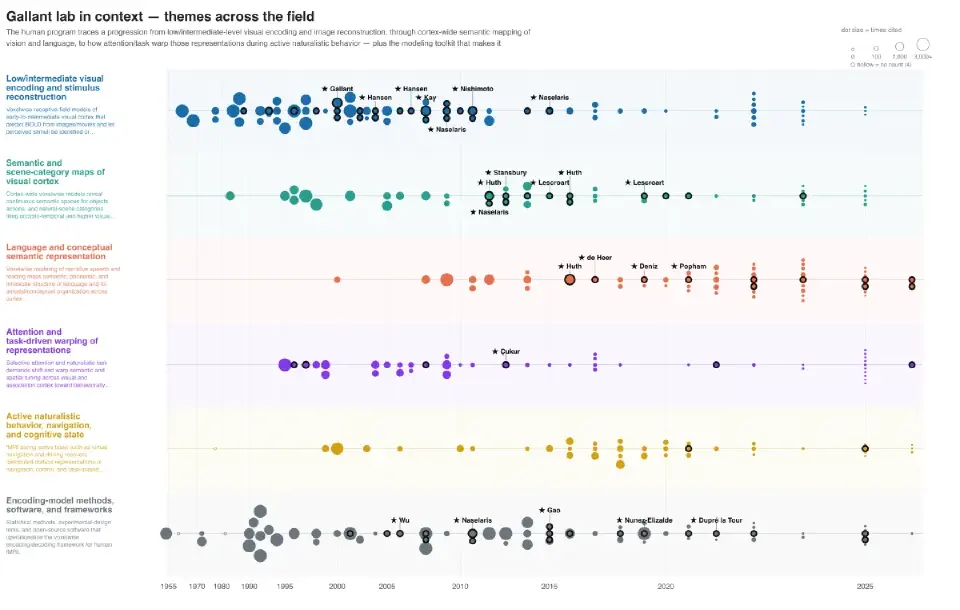
The mammalian cerebral cortex is a multi-scale biological computing device consisting of billions of neurons, arranged in layered, local circuits. Connections within and between these circuits are both convergent and divergent, and both feed-forward and feed-back connections are typical. The result is a hierarchical, parallel, highly interconnected network of areas that tile the cerebral cortex.
The information represented in each cortical area reflects a nonlinear sum of the information in all areas that provide input to it. Thus, each area represents information explicitly that is only implicit in the input. The central goal of our research program is to discover how the mammalian brain represents information about the world and about its own mental states, by identifying and characterizing these cortical maps.
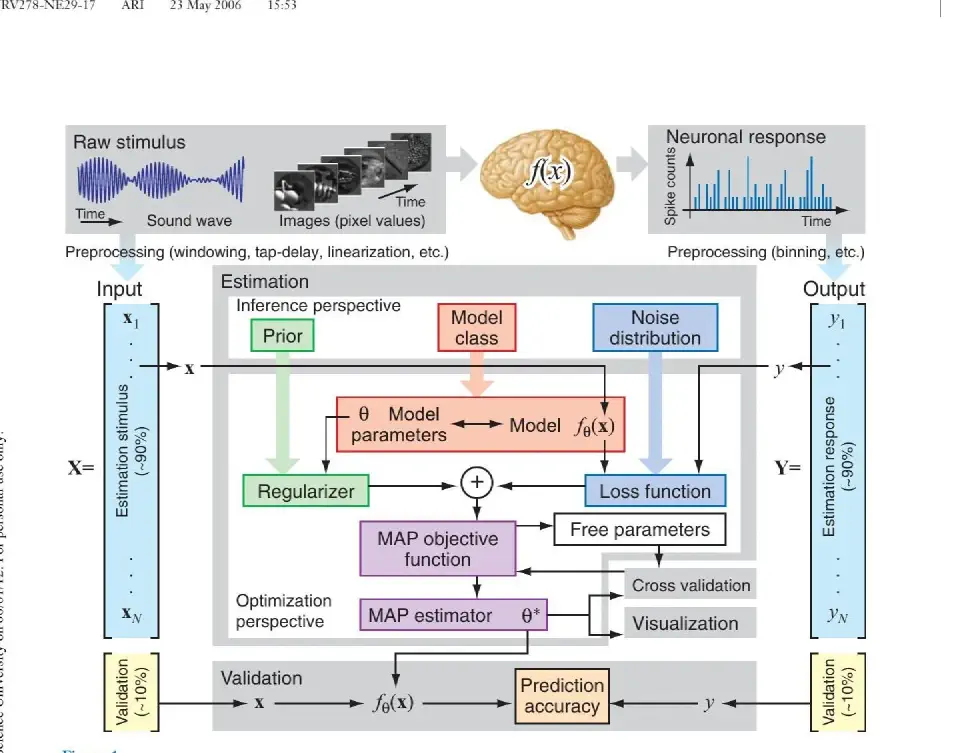
To address this problem, our laboratory makes heavy use of an inductive scientific approach called system identification, which is the foundation of the Voxelwise Encoding Model framework described below. Most of our data come from functional magnetic resonance imaging (fMRI) studies collected under very general conditions: while subjects watch long movies, listen to audio stories, or play video games. When necessary, we supplement this approach with targeted experiments optimized to test very specific hypotheses about brain function.
We then use classical statistical tools, Bayesian analysis and machine learning to fit computational models to the brain data. (These are usually called “encoding models”, because they describe how information about the world is encoded in the brain.) We evaluate several competing models to find the one that most accurately predicts responses, using a separate data set that was not used to estimate the model. The resulting encoding models describe what specific information is represented explicitly at each location across the cerebral cortex. These models are fit using himalaya, an open source Python package developed in our lab that estimates encoding models efficiently on both CPU and GPU hardware. A hands-on tutorial walks through the entire pipeline, from defining features to visualizing results on flattened cortical maps.
Our experiments generate large, rich data sets that cannot be summarized in a single number, so we develop software optimized for visualizing our results. Most notably, we developed the open source pycortex software for visualizing functional brain data (paper). Our brain viewers provide several demonstrations of this software.
Encoding models that accurately predict brain activity are the gold standard of systems and cognitive neuroscience, but they also have many practical uses. They provide a new tool for neurological evaluation and diagnosis, and a critical foundation for developing therapies to repair brain damage. They can also be inverted by means of a Bayesian framework in order to decode brain activity, which provides a direct and principled way to do “brain decoding”, and to build brain-machine interfaces (BMI) and neural prosthetics.
If you would like to know more about the general philosophy of the lab, please listen to this Freakonomics podcast interview with Jack Gallant or to these OHBM discussions between Peter Bandettini and Jack Gallant (discussion 1, discussion 2).
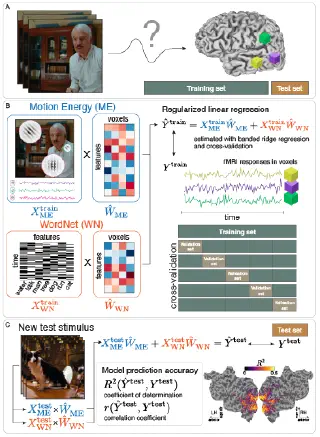
Voxelwise Encoding Model review paper

Voxelwise Encoding Model tutorials
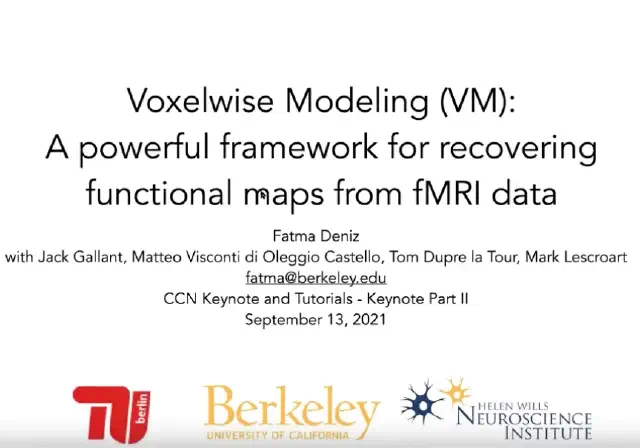
Voxelwise Encoding Model workshop video
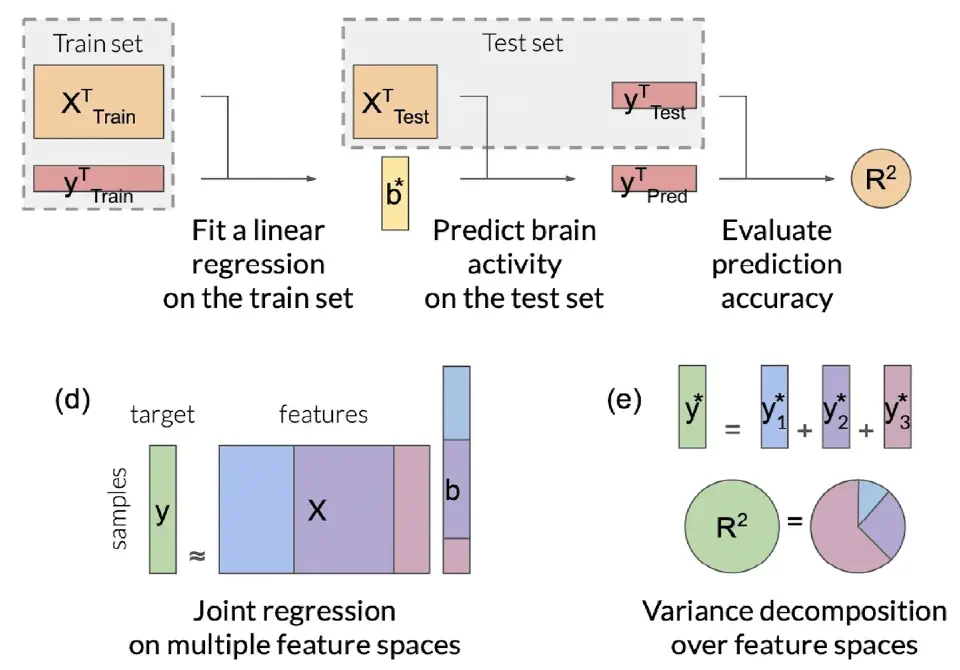
Theory paper focusing on feature space selection and banded ridge regression.
2022-12-01